How a simple idea from Australian educator Maggie Dent might give language to something Surf Life Saving has been doing for generations
Think about someone who shaped you early in your SLS journey. Not necessarily the person who assessed you, or the one who handed you your certificate. Think about the one you really remember. Maybe they were a patrol captain who never yelled when things went sideways in the water. A trainer who noticed you struggling on your third resuscitation attempt and quietly said something that helped you find your feet. A senior member who just had a way of making you feel like you belonged out there, even before you were sure you did.
Now think about the young members coming through your club right now. Someone on your SRC course. Someone you trained for their Bronze. A nipper who aged up this season and is struggling to figure out where they fit.
Whether you are aware of it or not, you may already be one of the most important adults in their world outside their home.
This is the idea at the centre of the Lighthouse Model, developed by Australian educator, author and resilience specialist Maggie Dent.
Hi, I’m Manny! I’m the Deputy Chief Training Officer, former CTO, Trainer, Patrolling Member and Youth Mentor at Bilgola SLSC. I stumbled across the Lighthouse Model during a workshop I was doing and it struck a chord for me. What followed was a proper deep dive… tracking down the original source, reading the research behind it and working through Maggie Dent’s broader body of work. It resonated with a lot of things I had both consciously and unconsciously been doing as a youth mentor. I became a lifesaver in 2018. It wasn’t long after that when youth mental health and lifesaving collided in an emergency incident I was involved in. Since then, I followed in my big sister’s footsteps and became a trained volunteer mentor for Raise Foundation which I’ve been doing for 6 years now. Youth mentorship is the thing I am most passionate about as a trainer at my surf club. I am very deliberate about it and Maggie Dent’s teachings made me want to inspire and facilitate other clubs being more deliberate about it too.
A live in-person and online presentation on the Lighthouse leadership and mentoring is taking place on the evening of Wednesday, the 21st of October. This event is open to leaders and volunteers from any surf club as well as anyone in the broader community who works with or cares about young people. REGISTER HERE.
What the Lighthouse Model actually says
Maggie Dent’s Lighthouse Model, detailed in her resource The Lighthouse Model for Secondary Schools and explored across her broader body of work, begins with a straightforward observation about adolescence. As young people pull away from their parents to develop independence, they do not actually need adults less. They need different adults. Trusted, non-parental adults who show up consistently, who see them clearly, and who can hold steady when things get difficult.
Dent calls these adults Lighthouses.
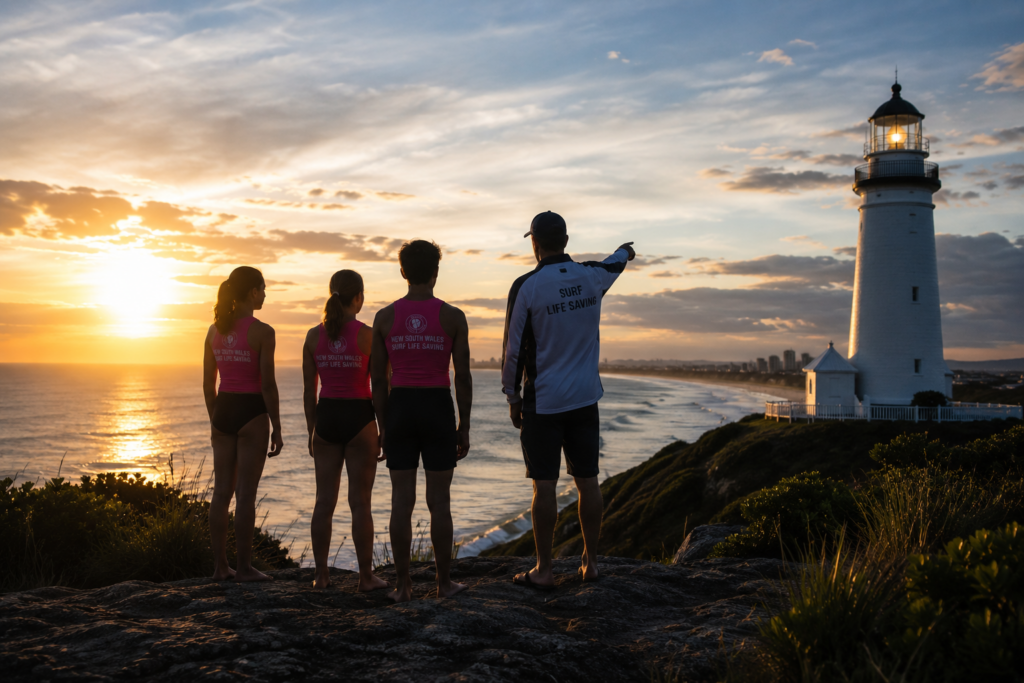
The metaphor is deliberate of course, and worth unpacking. A lighthouse does not chase ships. It does not grab the wheel. It does not remove the rough weather. It simply stays visible, stays dependable and helps people navigate. That is its primary role. And in the right conditions, it can be the difference between a safe passage and a disaster.
Dent identifies ten areas through which a Lighthouse adult can support healthy adolescent development. They include having genuine knowledge of what adolescents are going through neurologically and emotionally, having the courage to care even when it is hard, being trustworthy and consistent, offering hope and encouragement, building connectedness through genuine acceptance, teaching life skills and encouraging mastery, helping young people manage big emotional states, communicating in ways that build confidence rather than erode it, offering guidance only when asked and stepping back when not, and strengthening the spirit through laughter, lightness and human warmth.
None of that requires a new qualification. None of it adds a line to your SLS duties. It is a way of being present rather than a thing to do.
For a deeper read on the framework, visit maggiedent.com, where Maggie also links to her TEDx Talk and a range of supporting resources.
Why this lands differently inside Surf Life Saving
The Lighthouse Model was written primarily for secondary schools. Aside from a metaphor that appears tailor-made for our organisation, there is an argument that Surf Life Saving offers something schools rarely can.
In a school, a student moves through teachers annually. The relationship is real, but it resets. In a surf club, relationships do not reset. A member who came through nippers may be trained for their SRC by the same person who helped their older sibling years before. As a fully fledged Bronzie, a young person might patrol under their old age manager who has been around since before they were born. Senior club members become familiar faces across months and years. The interactions stack up.
Surf Life Saving is also unusual because the responsibility is real. Not simulated. When a young member goes on patrol, they are doing something that matters to the community. They are counted on. There is a genuine connection between what they learn and what they contribute. That kind of trust, given early and progressively, does something important to a young person’s sense of themselves.
The SLSA Child Safe Policy, which guides how all of us work alongside young people in the movement, creates the right foundation for these relationships. It establishes professional boundaries, safeguarding obligations and standards of conduct that protect members. Within that foundation, and not despite it, there is significant space for the kind of consistent, positive adult presence that Maggie Dent describes. The SLS Child Safe Policy sets the floor. The Lighthouse Model is what’s possible in the space above it. Every day, in the ordinary moments of a training session, a patrol debrief or under the tent at a carnival.
Trusted relationships and clear boundaries aren’t opposites. They depend on each other. The healthiest lighthouse relationships in SLS happen precisely because they operate inside clear, safe structures.
The nurturing community we create inside our surf clubs gives young people the support they need to survive and thrive into adulthood.
Trainers, assessors, patrol captains, age managers. Already lighthouses.
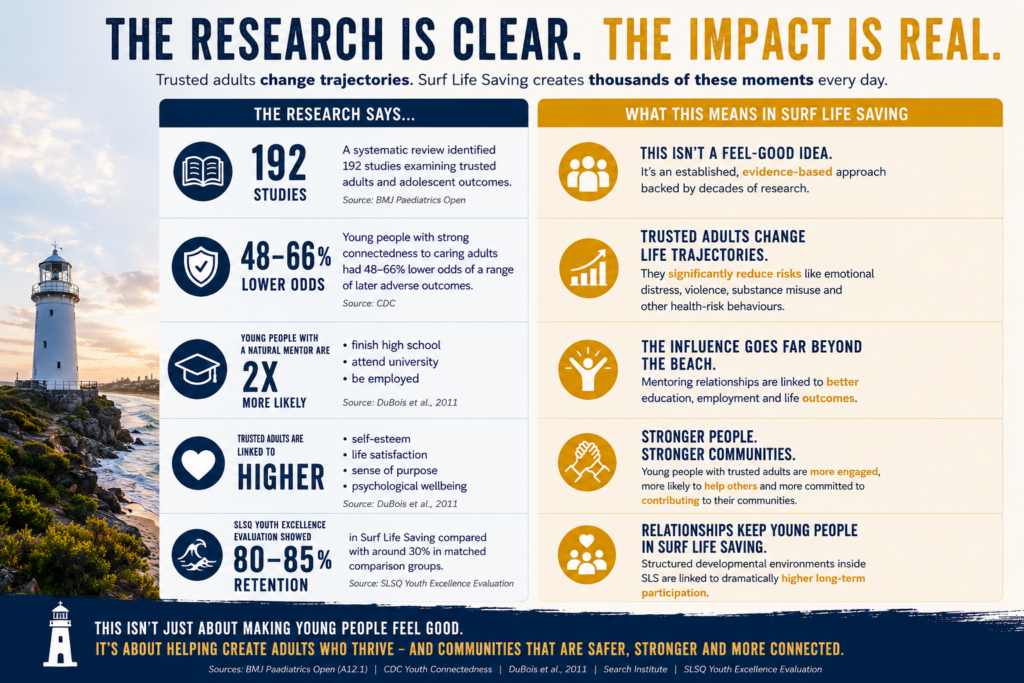
If you look at what the research on trusted adults actually says, there is one finding that comes through again and again. Young people trust behaviours not titles. The adult who becomes significant is not necessarily the one with the most impressive CV. It is the one who is consistent. Who remembers names. Who gives fair feedback without making it personal. Who stays calm under pressure and models what emotional steadiness looks like.
That description fits a lot of Surf Life Saving volunteers.
The trainer who creates psychological safety in a Bronze course so that candidates feel okay about not knowing everything yet. The assessor who shows up with empathy and kindness when a candidate needs to be told to return for another attempt. The patrol captain who debriefs the team after a busy Sunday and takes a moment to recognise what everyone did well. The age manager who makes a quiet kid feel like they matter in the water. The experienced patrol member who shows a first-season SRC how to set up the flags and takes the time to explain why.
None of those people were necessarily thinking about developmental influence when they showed up. They were thinking about doing their job well.
But those moments matter more than most of us realise. Belonging is a protective factor. Research on adolescent wellbeing consistently shows that feeling genuinely seen, valued and connected to a community of trusted adults has measurable effects on how young people navigate the hardest parts of growing up. Surf Life Saving creates the conditions for that kind of belonging at scale.
The ocean teaches things no trainer can fully explain in a classroom. Humility, patience, respect. The willingness to keep trying in conditions that are not going to change for you. Adult leaders in SLS don’t eliminate that challenge. They help young people learn to read it, work with it and grow through it. That is exactly what a lighthouse does.
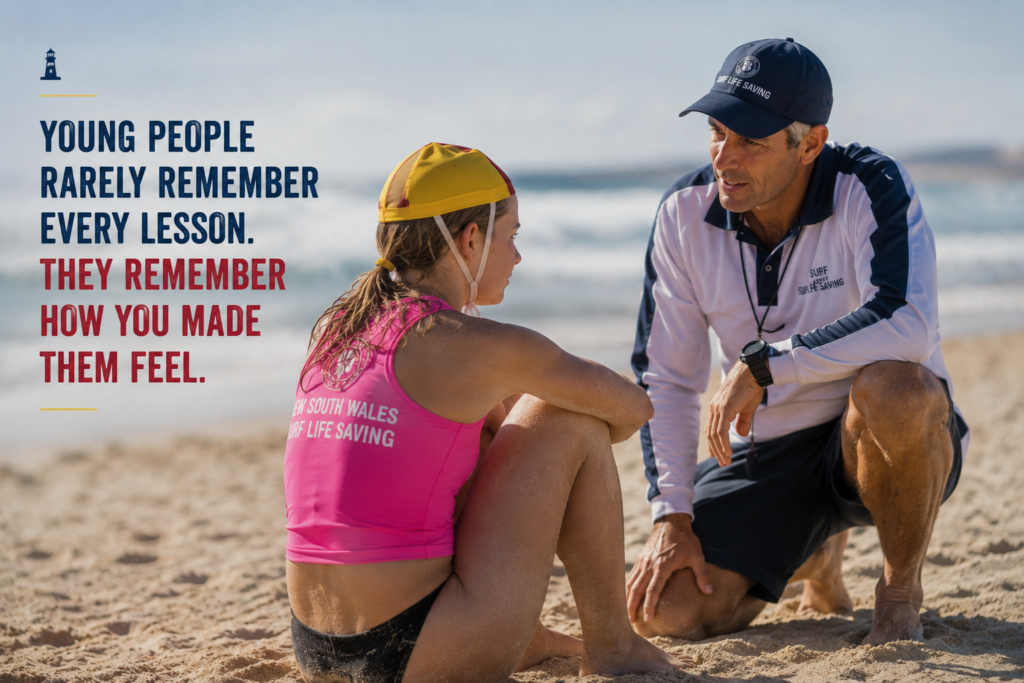
Surf Life Saving doesn’t need to create Lighthouse leaders. We already have thousands across our clubs. The opportunity is in helping more volunteers recognise the influence they already have, and use it with greater intention.
It’s not a question of whether you are a lighthouse. It’s whether you know you are.
The most experienced, most admired people in our clubs are often natural lighthouses without ever having heard that word. They got there through instinct, through their own formative experiences in the movement, and through a genuine care for the people around them. That is worth honouring.
But what would happen if more of us were deliberate about it?
Not deliberate in a way that is heavy or clinical or adds to the list of things volunteers are already asked to take on. Deliberate in the way that means you remember to learn the quiet candidate’s name early. You notice when someone who was full of energy on the first day has pulled back. You make sure your post-assessment conversation leaves a person’s dignity intact regardless of how they went. You say something honest and specific when someone has done something well.
Those are not extra duties. They are the texture of good leadership. Most of us are already reaching for them. The Lighthouse Model simply makes visible what the best version of that actually involves, and why it matters so much more than we often give ourselves credit for.
Self-Determination Theory, the framework increasingly used across volunteer organisations and leadership development to understand what keeps people engaged and thriving, describes three things every person needs: a sense of autonomy, a sense of competence and a sense of belonging. Surf Life Saving’s own leadership development programs recognise these needs. The Lighthouse approach is one way of understanding how everyday leadership behaviours serve all three, consistently, across a career of volunteer service. More importantly, how it can have a lasting impact on the lives of young people.
Surf Life Saving’s stated mission includes creating great Australians and building better communities. Beach safety is the beginning of that mission, not the end of it.
Some of us were shaped by this organisation in ways that go beyond the awards we hold. Someone was a lighthouse for us. Most of us could probably name them, even now. The next generation of members is walking onto our beaches right now. A few of them will carry someone from our clubs with them for the rest of their lives.
It might already be you, and you might not know it yet.
Surf Life Saving may be one of Australia’s richest natural environments for Lighthouse connections.
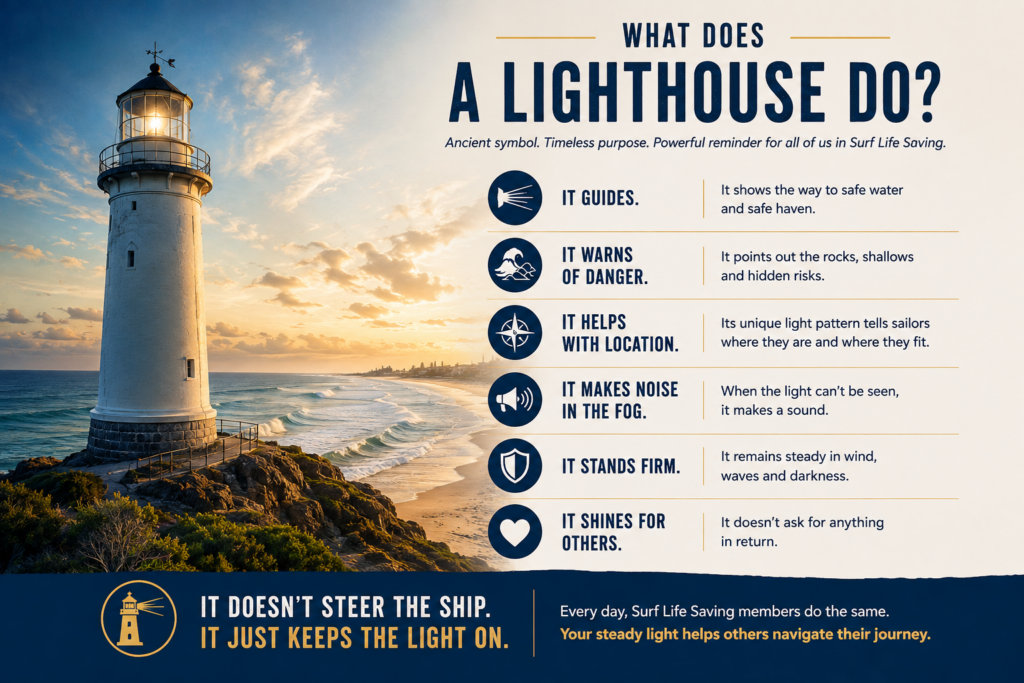
What Being a Lighthouse Can Look Like in Surf Life Saving
- Notice people. Learn names, especially those who are quiet or unsure where they fit.
- Be consistent. Sometimes simply turning up, week after week, builds more trust than any single conversation.
- Create psychological safety. Make it safe to ask questions, make mistakes and keep learning.
- Protect dignity. Whether someone passes or needs another attempt, leave them with their confidence intact.
- Hold high standards with empathy. Challenge people because you believe in what they are capable of becoming.
- Give responsibility progressively. Help young members grow by trusting them with meaningful opportunities.
- See potential before others see it in themselves. Sometimes a few words of belief change a person’s trajectory.
- Celebrate progress, not just achievement. Confidence is often built in the small wins that nobody else notices.
- Model calm under pressure. Young members learn as much from how you respond as from what you teach.
- Remember that every interaction matters. The conversation you barely remember may become one they never forget.
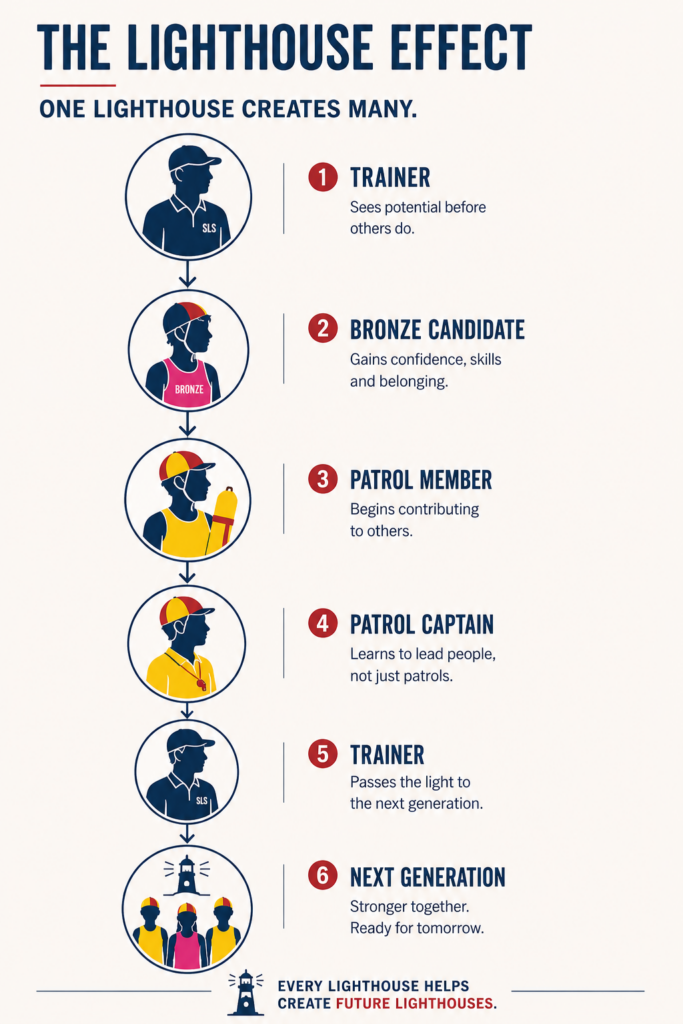
A lighthouse doesn’t shine because there are ships nearby. It shines because one day there might be. That’s what consistency is. You don’t know which conversation… Which patrol… Which training session… Which quiet word after an assessment… will be the one someone remembers for the next thirty years. So you keep the light on. Always
A live in-person & online presentation on the Lighthouse leadership and mentoring is taking place on the evening of Wednesday, the 21st of October. This event is open to leaders and volunteers from any surf club as well as anyone in the broader community who works with or cares about young people. REGISTER HERE.
The Lighthouse Model for Secondary Schools is an eBook by Maggie Dent, available at maggiedent.com. SLSA Policy 6.04 Child Safe (May 2026) guides all interactions with children and young people within Surf Life Saving and provides the governance foundation within which all member relationships operate. This article is offered to the Surf Life Saving movement as a starting point for conversation.